

Showing posts with label Greatest Moments. Show all posts
Showing posts with label Greatest Moments. Show all posts
Monday, 16 May 2016
Doctor Who: 10 Best TARDIS Teams

Sunday, 29 December 2013
Doctor Who's Greatest Moments - Part Five: The 10s (So Far)
In 2010, The Doctor regenerated. Usually on such occasions, viewers are eased through the change in the knowledge that even with a new Doctor, they are watching the same show. However, this time, Doctor Who itself regenerated. In as big a change as when the show returned to TV screens five years previously, it had an entirely fresh cast, headed by rising stars Matt Smith and Karen Gillan, and a all-new production team, led by newly-appointed head writer Steven Moffat. Anyone expecting this new incarnation of the show to continue on with Russell T Davies' Earth-rooted, often-angsty, 'proper drama' approach was in for a shock; Doctor Who was once again proud of its sci-fi status, with the stories becoming increasingly fantastical, and also its own history. The First Doctor's image can be seen a number of seven times in Series 5 alone, fact fans. In short, the Doctor Who of the 2010s (so far) has been 100% Doctor Who featuring some of the strongest characters and stories the show has ever seen. And, of course, some of its greatest moments...
 10.Goodbye Idris - The Doctor's Wife
Regular readers of this blog will know of my love for Neil Gaiman's The Doctor's Wife so it was bound to feature in here somewhere. The most affecting scene of the episode comes at its close when Idris, the Doctor's TARDIS trapped in a human body (yes, you read that right), is dying. This scene could have easily been over-egged but Idris' last words paired with Matt Smith breaking down get this blogger every time. 'Hello Doctor, it was so very nice to meet you.' Oh, here I go again....
 9. Which day would you choose? - A Christmas Carol
As if you needed more evidence that 2010s Who could do sad well no.9 goes to a touching scene from the triumphant 'A Christmas Carol'. Miserly Kazran Sardick has been keeping his dying love frozen in a box for decades, never releasing her knowing that they can spend but one more day together. This scene, and the episode as a whole, perfectly capture that Christmas sentimentality that you find in festive films such as It's a Wonderful Life, making this Who's finest Christmas special. Along with the scene above (although she was the TARDIS), this moment proves that Doctor Who even creates supporting one-off characters that break our hearts.
 8. River's reveal - A Good Man Goes To War
However, this era of the show is far from just about sobbing, on the contrary, it has become known for its timey-wimey plotting - and it doesn't come any timeier-wimier than the story of River Song. Finally, after the unsuccessful Battle of Demons Run, Amy and Rory (not to mention us) find out who the mysterious Dr Song is; Melody Pond, their daughter. It's a fantastic reveal, being one of those 'spanner-in-the-works' moments that Doctor Who (and particularly this version of it) can do so well. The moment of River's reveal perfectly captures the sense of the roller coaster that watching Doctor Who is; you might not know where it'll take you but you know it's going to be one hell of a ride.
 7. Clara was born to save the Doctor - The Name of the Doctor
As mentioned above, 2010s Who is very aware of its past, with references to all eras of the show appearing all over the shop. This reached its pinnacle in the opening few minutes of the Series 7 finale when the Doctor's companion, Clara, was seen bumping into every Doctor. Including, most excitingly, the First Doctor on Gallifrey at the very moment he ran away to see the stars. The contemporary series is the only incarnation of the show that would ever do something as audacious as literally delving into its own history in such a way and also putting on screen such a significant part of the Doctor's origins. Moments like this encourage us to remember that Doctor Who isn't just a television series that we like watching on Saturday teatimes, it's a continuing legend that's been running for half a century.
 6. The Pandorica speech - The Pandorica Opens
The Eleventh Doctor is good at speeches. And, at Stonehenge, in front of a legion of Romans, he delivered a belter. Every villain or monster he has ever faced has gathered in the skies for the Pandorica, an ancient mythical prison buried beneath the Henge. To stop all out war breaking out, the Doctor reminds them who is guarding it. 'Remember every black day I ever stopped you,' he says. 'And then - AND THEN - do the smart thing - let somebody else try first.' It's a bravura scene showcasing the fear the Doctor distills in his enemies, something not too well-explored at this point but has since become a running plot point (it was why he wiped his name from the universe, after all). Making the assembled horrors of the universe run away; the Eleventh Doctor is definitely good at speeches.
 5. Lake Silencio - The Impossible Astronaut
Once upon a time, Doctor Who season openers would feature babies made of fat or fun, frothy stories about body-swapping. Not anymore. Ten minutes into Series 6, millions of viewers were gobsmacked when, at a picnic in Utah, an impossible astronaut rose from the lake and killed the Doctor, stone dead. With out any breathing room, this shock plunges you into the heady mix of intrigue, questions and twists that is Series 6 with terrific assuredness and a true cinematic feel thanks to the overseas filming. Doctor Who nowadays doesn't just expect you to be in the room when its on, it wants you to be glued to the screen.
 4. Touched by an Angel - The Angels Take Manhattan
The longest-running companions of the post-2005 series, Amy and Rory, bowed out from the show when, after an exhausting adventure with the Weeping Angels, they met a solitary angel in a graveyard who sent them back in time. Amy's heartbreak at losing her husband, meaning she is willing to leave behind all of time and space, and her best friend to be reunited with him, answers the big question of their relationship since their introduction; Amy really does love Rory as much as he loves her. Particularly due to the performances of Matt Smith and Karen Gillan (for my money, the greatest Doctor-companion pairing we've ever seen) this is one of the saddest companion exits.
 3. 'A pile of good things and bad things' - Vincent and the Doctor
As already seen, as well as the big attention-grabbing moments, the series can still do quiet reflections better than anybody. After revealing to Vincent Van Gogh that he will be adored, Amy returns to her time hoping to find that they saved Van Gogh from killing himself. At finding out otherwise, Amy breaks down but the Doctor reminds her that they did do some good. 'Every life is a pile of good things and bad things,' he tells her. 'The good things don't often soften the bad things, but vice versa the bad things don't always spoil the bad things or make them unimportant.' Written by the versatile Richard Curtis, this episode deals with a troubled lonely man rather than alien invasions and in this moment talks philosophically about life in a way that would not alienate children.They say Doctor Who is a kid's show yet I guarantee very few post-watershed shows would feature a moment quite as mature as this one.
 2. 'Raggedy Man, Goodnight' - The Time of the Doctor
Granted a new regeneration cycle by the Time Lords, the Eleventh (or should that be Thirteenth?) Doctor is dying. But before he goes, he has time to reflect on the nature of change. 'We're all different people all through our lives,' says the Doctor. 'And that's OK... so long as you remember all the people you used to be...' Now this one was always going to be tear-jerking but Steven Moffat really pulls out all the stops to make sure we're blubbing all the way through our mince pies. The Doctor's brave speech of acceptance PLUS the dream of Amelia telling him goodnight PLUS the bow tie dropping to the floor are all sad individually but put together and topped off with Matt Smith crying (surely no sadder sight exists) produce possibly the most heart-rendering regeneration that would make even a Cyberman weep. Yet in a flash, a silver-haired man is making you laugh by talking about kidneys. That's Doctor Who.
 1. The Doctors Save Gallifrey - The Day of the Doctor

Regular readers of this blog will know of my love for Neil Gaiman's The Doctor's Wife so it was bound to feature in here somewhere. The most affecting scene of the episode comes at its close when Idris, the Doctor's TARDIS trapped in a human body (yes, you read that right), is dying. This scene could have easily been over-egged but Idris' last words paired with Matt Smith breaking down get this blogger every time. 'Hello Doctor, it was so very nice to meet you.' Oh, here I go again....

As if you needed more evidence that 2010s Who could do sad well no.9 goes to a touching scene from the triumphant 'A Christmas Carol'. Miserly Kazran Sardick has been keeping his dying love frozen in a box for decades, never releasing her knowing that they can spend but one more day together. This scene, and the episode as a whole, perfectly capture that Christmas sentimentality that you find in festive films such as It's a Wonderful Life, making this Who's finest Christmas special. Along with the scene above (although she was the TARDIS), this moment proves that Doctor Who even creates supporting one-off characters that break our hearts.

However, this era of the show is far from just about sobbing, on the contrary, it has become known for its timey-wimey plotting - and it doesn't come any timeier-wimier than the story of River Song. Finally, after the unsuccessful Battle of Demons Run, Amy and Rory (not to mention us) find out who the mysterious Dr Song is; Melody Pond, their daughter. It's a fantastic reveal, being one of those 'spanner-in-the-works' moments that Doctor Who (and particularly this version of it) can do so well. The moment of River's reveal perfectly captures the sense of the roller coaster that watching Doctor Who is; you might not know where it'll take you but you know it's going to be one hell of a ride.
 7. Clara was born to save the Doctor - The Name of the Doctor
As mentioned above, 2010s Who is very aware of its past, with references to all eras of the show appearing all over the shop. This reached its pinnacle in the opening few minutes of the Series 7 finale when the Doctor's companion, Clara, was seen bumping into every Doctor. Including, most excitingly, the First Doctor on Gallifrey at the very moment he ran away to see the stars. The contemporary series is the only incarnation of the show that would ever do something as audacious as literally delving into its own history in such a way and also putting on screen such a significant part of the Doctor's origins. Moments like this encourage us to remember that Doctor Who isn't just a television series that we like watching on Saturday teatimes, it's a continuing legend that's been running for half a century.

The Eleventh Doctor is good at speeches. And, at Stonehenge, in front of a legion of Romans, he delivered a belter. Every villain or monster he has ever faced has gathered in the skies for the Pandorica, an ancient mythical prison buried beneath the Henge. To stop all out war breaking out, the Doctor reminds them who is guarding it. 'Remember every black day I ever stopped you,' he says. 'And then - AND THEN - do the smart thing - let somebody else try first.' It's a bravura scene showcasing the fear the Doctor distills in his enemies, something not too well-explored at this point but has since become a running plot point (it was why he wiped his name from the universe, after all). Making the assembled horrors of the universe run away; the Eleventh Doctor is definitely good at speeches.

Once upon a time, Doctor Who season openers would feature babies made of fat or fun, frothy stories about body-swapping. Not anymore. Ten minutes into Series 6, millions of viewers were gobsmacked when, at a picnic in Utah, an impossible astronaut rose from the lake and killed the Doctor, stone dead. With out any breathing room, this shock plunges you into the heady mix of intrigue, questions and twists that is Series 6 with terrific assuredness and a true cinematic feel thanks to the overseas filming. Doctor Who nowadays doesn't just expect you to be in the room when its on, it wants you to be glued to the screen.

The longest-running companions of the post-2005 series, Amy and Rory, bowed out from the show when, after an exhausting adventure with the Weeping Angels, they met a solitary angel in a graveyard who sent them back in time. Amy's heartbreak at losing her husband, meaning she is willing to leave behind all of time and space, and her best friend to be reunited with him, answers the big question of their relationship since their introduction; Amy really does love Rory as much as he loves her. Particularly due to the performances of Matt Smith and Karen Gillan (for my money, the greatest Doctor-companion pairing we've ever seen) this is one of the saddest companion exits.

As already seen, as well as the big attention-grabbing moments, the series can still do quiet reflections better than anybody. After revealing to Vincent Van Gogh that he will be adored, Amy returns to her time hoping to find that they saved Van Gogh from killing himself. At finding out otherwise, Amy breaks down but the Doctor reminds her that they did do some good. 'Every life is a pile of good things and bad things,' he tells her. 'The good things don't often soften the bad things, but vice versa the bad things don't always spoil the bad things or make them unimportant.' Written by the versatile Richard Curtis, this episode deals with a troubled lonely man rather than alien invasions and in this moment talks philosophically about life in a way that would not alienate children.They say Doctor Who is a kid's show yet I guarantee very few post-watershed shows would feature a moment quite as mature as this one.

Granted a new regeneration cycle by the Time Lords, the Eleventh (or should that be Thirteenth?) Doctor is dying. But before he goes, he has time to reflect on the nature of change. 'We're all different people all through our lives,' says the Doctor. 'And that's OK... so long as you remember all the people you used to be...' Now this one was always going to be tear-jerking but Steven Moffat really pulls out all the stops to make sure we're blubbing all the way through our mince pies. The Doctor's brave speech of acceptance PLUS the dream of Amelia telling him goodnight PLUS the bow tie dropping to the floor are all sad individually but put together and topped off with Matt Smith crying (surely no sadder sight exists) produce possibly the most heart-rendering regeneration that would make even a Cyberman weep. Yet in a flash, a silver-haired man is making you laugh by talking about kidneys. That's Doctor Who.

Many moments from the past four years could have made number one. The reunion of Rory with an older Amy in 'The Girl Who Waited'? The hilarity of the mismatched Doctor and Craig from 'The Lodger'? The Doctor's tale of the TARDIS at Amelia's bedside in 'The Big Bang'? However, the top spot had to go to this scene from the spectacular 50th anniversary special from last month; what could be better than all the Doctor's working together to save the most important day in all of their lives?
To save himself from destroying Gallifrey, all twelve of the Doctor's incarnations (no, all thirteen!) team up to save his home world from the might of the Daleks and shunt it into another universe. With all of his guilt relieved, the Doctor has a new goal. He is not running away from Gallifrey, as before, but running towards it. A celebration of fifty years of Doctor Who, intervening into its own past, taking the show in a brand new direction as well as carrying an emotional weight, this scene literally has it all.
Just like the moments in 60s Doctor Who inspired Steven Moffat and Russel T Davies to grow up and write for the show, maybe this moment and the preceding nine will enthuse a whole new generation of fans. Doctor Who is the reason for its own longevity simply because, although it constantly changes, as this series of posts show, in whatever incarnation it is in, Doctor Who is always supreme television delivering moments of drama, pathos and, most importantly, fun. And as long as its keeps on doing that, there's no reason it should stop.
Just like the moments in 60s Doctor Who inspired Steven Moffat and Russel T Davies to grow up and write for the show, maybe this moment and the preceding nine will enthuse a whole new generation of fans. Doctor Who is the reason for its own longevity simply because, although it constantly changes, as this series of posts show, in whatever incarnation it is in, Doctor Who is always supreme television delivering moments of drama, pathos and, most importantly, fun. And as long as its keeps on doing that, there's no reason it should stop.
Friday, 29 November 2013
Doctor Who's Greatest Moments: Part Four - The 00s
After sixteen years in the wilderness (apart from one TV movie), Doctor Who returned to the nations' screens anew. Previously seen in the public consciousness as a cheerful children's show with wobbly sets and cheap monster costumes, viewers had their prejudices blown away when, in 2005, acclaimed writer Russell T Davies brought it back as a 'proper drama.' Of course, fans had always seen it that way but now the rest of the world had caught up. Doctor Who was prime time material once again - but there were a few changes. It was grounded in human characters and relationships, rooted to modern-day Earth and, most importantly, that eccentric wizard Doctor was now a survivor of a terrible war, recovering from the horror he had seen. However, underneath it was still exactly the same show, with the same brew of humour, drama and scares that had made the original twenty-six year run a success. The Doctor Who of the 00s was greater than ever before - and so were the moments...
 10. Run! - Rose
Let's start at the beginning. Shop girl Rose Tyler is at the end of another boring day when things take an unexpected turn - confronted by living dummies in a stock room she encounters a strange man who takes her hand and tells her to run. And her life is never the same again.
A perfect kicking point for the adventure, this moment absolutely captures the effect meeting the Doctor has to a companion's perspective. You have a normal, boring life and then suddenly the Doctor appears, a wonderful, charming, insane man, with danger all around him. When the Doctor tells her to run, Rose does. And if the Doctor did the same to you, wouldn't you run too?
 9. Don't Blink - Blink
Inquisitive (and all round fantastic character wonderfully played by Carey Mulligan who - ok, I'll stop now) Sally Sparrow has been caught up in a mystery involving the predatory statues, the Weeping Angels. In spooky old house, she and Larry Nightingale stick on a DVD - a message from the Doctor, giving them advice on how to escape the angels... that are (slowly) gaining on them. This scene makes it onto the list as the most memorable scene in arguably the most memorable episode of Doctor Who. Exceedingly clever and scary in equal measure, it properly established the most notorious monster of the 00s series. If you're walking through a graveyard and you come across a statue of angel, there's just one thing you have to remember: don't turn your back and, whatever you do, don't blink. Good luck.
 8. The Family lives forever - The Family of Blood
At the end of exceptional two-parter 'Human Nature/The Family of Blood', after leading another life as a human, the Doctor returns and punishes those who forced him to change his identity in the first place - the Family of Blood - in particularly harsh ways. Father of Mine he wrapped in unbreakable chains, forged in the heart of a dwarf star, Mother of Mine was tricked into the event horizon of a collapsing sun, Sister of Mine became trapped inside a mirror world and Son of Mine was put into suspended animation to watch over England's fields - as a scarecrow. They wanted to live forever,' says Son of Mine (Harry Lloyd, in one of the show's best guest performances in recent years), 'so he made sure that we did. Obviously the Family were nasty individuals, but the callous comeuppances the Doctor dishes out to them are rather chilling examples of the dark edges of the Doctor's character.
 7. Everybody lives! - The Doctor Dances
On the exact opposite side of the Doctor, we have this triumphant moment from Steven Moffat's cracking Doctor Who debut 'The Empty Child/The Doctor Dances.' With half of war-torn London converted into gasmask zombies, it all looks bleak for humanity until the Doctor is able to guide the nanogenes that created the virus into mending everyone affected. 'Everybody lives,' cries an ebullient Ninth Doctor,' just this once, everybody lives!' It is an extremely rare occurrence that everyone survives a Doctor Who story (it's contains an inordinate amount of death for a family-aimed series) but here the Doctor has his greatest wish granted - he saves everyone. It's wonderful to see the Ninth Doctor, often morose and hurt (oh no, he came before), so full of joy. A heartwarmer.
 6. Time Lord Victorious - The Waters of Mars
However, it's not always so easy to save everyone, as the Tenth Doctor found out in his penultimate adventure 'The Waters of Mars.'
The defining characteristic of the Tenth Doctor could be said to be how much he felt the losses he had experienced in his long life. From his own people to Rose Tyler, he could hardly take it when he failed to save someone. Here, it seems the Doctor finally snaps and resolves to break the laws of time to save the crew of Bowie Base One on Mars from their deaths, a fixed point in time. His ego boiling over to dangerous levels, the Doctor proclaims himself 'Time Lords Victorious' and that time 'will obey [him].' The scene is such an important one as it details perhaps one of the significant changes to the Doctor's character in the entire series. For a few moments, in his manic state and blind assuredness, the Doctor virtually becomes the Master - prepared to do anything to get what he wants. This growing coldness to the character could be said to stem from a terrible event in his past...
 5. The Survivors of the Time War - Dalek
Locked away in billionaire alien collector Henry Van Statten's vault, the Doctor is horrified to find a lone Dalek survived the Time War (give it a while, Doc, and I'm afraid you'll find there's a lot more). Despite both being the last of their kind, the last soldiers of the Time War, the Doctor is blinkered with his hatred for the Daleks and his usual compassion dissipates. In many ways the Dalek is more human in this scene, despondent and alone, while the Doctor gloats about the Dalek species' destruction - and even tries to 'exterminate' it before Van Statten intervenes.
Making the Dalek the fearsome force it hadn't been since the 60s, this scene really captures the impact the Time War had on the Doctor. A fine example of how the revived series knows how to pitch the drama of the series perfectly.
 4. 'I'm regenerating...!' - The Stolen Earth
The cliffhanger of Series 4 finale 'The Stolen Earth/Journey's End' is one of Doctor Who's most 'coffee-spurting' scenes. Finally about to see Rose again, the Doctor is shot down by a Dalek - and begins to regenerate! For a whole week, the entire viewing public believed that come next Saturday David Tennant would cease to be the Doctor. Of course, at the beginning of the following episode we found out it wasn't the case - the Doctor is able to siphon the excess regenerative energy into his spare hand in a jar (just accept it). But this scene meant that, at the height of its 00s popularity as it was, Doctor Who was the focus point of every conversation in Britain (or at least at my school, ah those were the days) for seven days and so it stands as a testament to the power Doctor Who has in grabbing people's attention. Every now and then, it likes to remind us that it's the biggest drama on TV.
 3. 'I think you need a Doctor...' - The Parting of the Ways
The Daleks have conquered the Earth. Yeah, I know, we've heard it a dozen times but this time they really are unstoppable. Unless you're Rose Tyler, and you've hoovered up the heart of the TARDIS to become a God-like entity. Deux Ex Machina it may be, but this end to one of the series' strongest sees the touching demise of Eccleston's Doctor. In exactly the way the Doctor should go, he sacrifices himself to save his companion. Restrained but emotional, the Doctor gives a few last jokes, almost says his feelings for Rose and bows out with grace and gravitas. While Eccleston is not my favourite of all-time Doctor, he is most probably the best all-round actor to play the role, and watching him here it's hard to say differently. He is simply fantastic.
 2. The Most Important Woman in the Whole of Creation - Journey's End
It seems that the aforementioned Series 4 finale had two brilliant episode closes with the, uh, end of 'Journey's End' being the devastating farewell to companion Donna Noble. After touching the Doctor' spare hand, full of regenerative energy, Donna gained the Doctor's mind - becoming the DoctorDonna, part human, part Time Lord. However, it was impossible for anyone to hold all the Doctor's knowledge in their head and so, to save her life, the Doctor had to wipe Donna's mind of all her adventures with him. The growth of Donna from mouthy trivia-obsessed temp to a grown-up woman who realised her true potential was the story of Series 4 and so to have the character robbed of not only her wonderful time in the TARDIS but also her improved sense of self-worth is utterly heartbreaking. The script and the fine performances of Tennant and Catherine Tate collide here to create the saddest companion exit ever.
 1. I'm the Last of the Time Lords - The End of the World
While there may be funnier, snappier moments out there this affecting scene sums up the ethos of the Doctor Who of the 00s and so claims the decade's greatest moment. After witnessing 'The End of the World', the Doctor and Rose return to modern-day London. Reflecting on how nothing lasts forever, the Doctor reveals who he really is; the last of his race, the Time Lords, who were destroyed in the Last Great Time War. A discussion of cosmic battles between alien races, but fuelled with such emotion - and taking place in an everyday street - this scene is quite simply 100% 00s Doctor Who. Just as 'The Day of the Doctor' recently made a major move to ensure the longevity of Doctor Who, this scene - and the changes it brought to the series - guaranteed that Doctor Who came back changed but still the same - letting it sail into its 50th anniversary and beyond.
 10. Run! - Rose
Let's start at the beginning. Shop girl Rose Tyler is at the end of another boring day when things take an unexpected turn - confronted by living dummies in a stock room she encounters a strange man who takes her hand and tells her to run. And her life is never the same again.
A perfect kicking point for the adventure, this moment absolutely captures the effect meeting the Doctor has to a companion's perspective. You have a normal, boring life and then suddenly the Doctor appears, a wonderful, charming, insane man, with danger all around him. When the Doctor tells her to run, Rose does. And if the Doctor did the same to you, wouldn't you run too?
 9. Don't Blink - Blink
Inquisitive (and all round fantastic character wonderfully played by Carey Mulligan who - ok, I'll stop now) Sally Sparrow has been caught up in a mystery involving the predatory statues, the Weeping Angels. In spooky old house, she and Larry Nightingale stick on a DVD - a message from the Doctor, giving them advice on how to escape the angels... that are (slowly) gaining on them. This scene makes it onto the list as the most memorable scene in arguably the most memorable episode of Doctor Who. Exceedingly clever and scary in equal measure, it properly established the most notorious monster of the 00s series. If you're walking through a graveyard and you come across a statue of angel, there's just one thing you have to remember: don't turn your back and, whatever you do, don't blink. Good luck.
 8. The Family lives forever - The Family of Blood
At the end of exceptional two-parter 'Human Nature/The Family of Blood', after leading another life as a human, the Doctor returns and punishes those who forced him to change his identity in the first place - the Family of Blood - in particularly harsh ways. Father of Mine he wrapped in unbreakable chains, forged in the heart of a dwarf star, Mother of Mine was tricked into the event horizon of a collapsing sun, Sister of Mine became trapped inside a mirror world and Son of Mine was put into suspended animation to watch over England's fields - as a scarecrow. They wanted to live forever,' says Son of Mine (Harry Lloyd, in one of the show's best guest performances in recent years), 'so he made sure that we did. Obviously the Family were nasty individuals, but the callous comeuppances the Doctor dishes out to them are rather chilling examples of the dark edges of the Doctor's character.
 7. Everybody lives! - The Doctor Dances
On the exact opposite side of the Doctor, we have this triumphant moment from Steven Moffat's cracking Doctor Who debut 'The Empty Child/The Doctor Dances.' With half of war-torn London converted into gasmask zombies, it all looks bleak for humanity until the Doctor is able to guide the nanogenes that created the virus into mending everyone affected. 'Everybody lives,' cries an ebullient Ninth Doctor,' just this once, everybody lives!' It is an extremely rare occurrence that everyone survives a Doctor Who story (it's contains an inordinate amount of death for a family-aimed series) but here the Doctor has his greatest wish granted - he saves everyone. It's wonderful to see the Ninth Doctor, often morose and hurt (oh no, he came before), so full of joy. A heartwarmer.
 6. Time Lord Victorious - The Waters of Mars
However, it's not always so easy to save everyone, as the Tenth Doctor found out in his penultimate adventure 'The Waters of Mars.'
The defining characteristic of the Tenth Doctor could be said to be how much he felt the losses he had experienced in his long life. From his own people to Rose Tyler, he could hardly take it when he failed to save someone. Here, it seems the Doctor finally snaps and resolves to break the laws of time to save the crew of Bowie Base One on Mars from their deaths, a fixed point in time. His ego boiling over to dangerous levels, the Doctor proclaims himself 'Time Lords Victorious' and that time 'will obey [him].' The scene is such an important one as it details perhaps one of the significant changes to the Doctor's character in the entire series. For a few moments, in his manic state and blind assuredness, the Doctor virtually becomes the Master - prepared to do anything to get what he wants. This growing coldness to the character could be said to stem from a terrible event in his past...
 5. The Survivors of the Time War - Dalek
Locked away in billionaire alien collector Henry Van Statten's vault, the Doctor is horrified to find a lone Dalek survived the Time War (give it a while, Doc, and I'm afraid you'll find there's a lot more). Despite both being the last of their kind, the last soldiers of the Time War, the Doctor is blinkered with his hatred for the Daleks and his usual compassion dissipates. In many ways the Dalek is more human in this scene, despondent and alone, while the Doctor gloats about the Dalek species' destruction - and even tries to 'exterminate' it before Van Statten intervenes.
Making the Dalek the fearsome force it hadn't been since the 60s, this scene really captures the impact the Time War had on the Doctor. A fine example of how the revived series knows how to pitch the drama of the series perfectly.
 4. 'I'm regenerating...!' - The Stolen Earth
 3. 'I think you need a Doctor...' - The Parting of the Ways
The Daleks have conquered the Earth. Yeah, I know, we've heard it a dozen times but this time they really are unstoppable. Unless you're Rose Tyler, and you've hoovered up the heart of the TARDIS to become a God-like entity. Deux Ex Machina it may be, but this end to one of the series' strongest sees the touching demise of Eccleston's Doctor. In exactly the way the Doctor should go, he sacrifices himself to save his companion. Restrained but emotional, the Doctor gives a few last jokes, almost says his feelings for Rose and bows out with grace and gravitas. While Eccleston is not my favourite of all-time Doctor, he is most probably the best all-round actor to play the role, and watching him here it's hard to say differently. He is simply fantastic.
 2. The Most Important Woman in the Whole of Creation - Journey's End
It seems that the aforementioned Series 4 finale had two brilliant episode closes with the, uh, end of 'Journey's End' being the devastating farewell to companion Donna Noble. After touching the Doctor' spare hand, full of regenerative energy, Donna gained the Doctor's mind - becoming the DoctorDonna, part human, part Time Lord. However, it was impossible for anyone to hold all the Doctor's knowledge in their head and so, to save her life, the Doctor had to wipe Donna's mind of all her adventures with him. The growth of Donna from mouthy trivia-obsessed temp to a grown-up woman who realised her true potential was the story of Series 4 and so to have the character robbed of not only her wonderful time in the TARDIS but also her improved sense of self-worth is utterly heartbreaking. The script and the fine performances of Tennant and Catherine Tate collide here to create the saddest companion exit ever.
 1. I'm the Last of the Time Lords - The End of the World
 While there may be funnier, snappier moments out there this affecting scene sums up the ethos of the Doctor Who of the 00s and so claims the decade's greatest moment. After witnessing 'The End of the World', the Doctor and Rose return to modern-day London. Reflecting on how nothing lasts forever, the Doctor reveals who he really is; the last of his race, the Time Lords, who were destroyed in the Last Great Time War. A discussion of cosmic battles between alien races, but fuelled with such emotion - and taking place in an everyday street - this scene is quite simply 100% 00s Doctor Who. Just as 'The Day of the Doctor' recently made a major move to ensure the longevity of Doctor Who, this scene - and the changes it brought to the series - guaranteed that Doctor Who came back changed but still the same - letting it sail into its 50th anniversary and beyond.
Wednesday, 13 November 2013
My Top Three Doctor Who Stories: The Doctor's Wife by Neil Gaiman
In the lead-up to Doctor Who's fiftieth birthday - it's only David Tennant days away, folks! - I'm penning a trilogy of posts concerning my three favourite Doctor Who stories ever. It's a tough choice, to boil down (debatably) 238 stories down to just three but, after much deliberation, I have made my choice. First up, we go to the scrapyard at the end of the universe to meet a very important woman to the Doctor, his soul mate, his significant other, you might say, his... well, his TARDIS.


It's quite hard to describe Doctor Who to someone who's never seen it before. The main character,you might say, is an alien. Oh, they reply, what kind of alien? Actually, he looks human. Who plays him? Hmm, several people. Okaaayy, well, where is it set? Oh, boy...
The one way you can sum it up is about a man and his blue box, with the occasional stray, who go travelling around time and space. That broadly encapsulates every Doctor Who story under one (question-marked) umbrella. Every story, that is, apart from 'The Doctor's Wife'.
In this episode, acclaimed writer Neil Gaiman takes this core idea of Doctor Who and completely turns it on his head. What if the TARDIS wasn't a police box but a woman? Landing in a bubble universe outside our own, The TARDIS' internal matrix - it's soul - is ousted by the machine and put in the body of human woman. The episode involves a wonderful subplot with Amy and Rory trapped in a dangerous TARDIS (complete with CORRIDORS - trust me, corridors are exciting) but its core is the relationship between the constant companions, the Doctor and his TARDIS. What exactly are they to each other? Who owns who? Are they mother and son? Husband and wife? It's left suitably undefined but we see that they are perfectly matched for the other. The Doctor's loneliness as the last of the Time Lords is here temporarily lifted; until the eventual heartbreaking end. TARDISes aren't meant to live in human bodies...
A great strength of this episode is its use of Doctor Who continuity that, rather than seeming superfluous and shoehorned in, adds another layer to the story. References go from The Doctor's leaving from Gallifrey (untouched in the series up that point but recently seen in 'The Name of the Doctor') to the Eleventh Doctor's first episode (in his calling the TARDIS 'sexy') and many others in between. Other stories have chucked this many references to earlier episodes in, making the whole feel like its desperately trying to please fans but merely ends up alienating most of the audience. Gaiman, on the other hand, handles the kisses to the past beautifully in a way that celebrates the legend of the show. The upcoming 'The Day of the Doctor' could do far worse than to take its lead from this story in how to commemorate Doctor Who's long and illustrious history.
Away from the excellent script, Gaiman's words are brought to life by some tremendous acting. While Karen Gillan and Arthur Darvill are of course endearing as Amy and Rory they are secondary characters, although Darvill does get to do some frightening crazed Rory acting and Karen, the horror of believing that she's lost her husband (again). Also, a nod must be made to the talented Michael Sheen who lends his voice to House, the sentient asteroid that eats TARDISes. It's a shame you can't really hear its him but there's still a certain gleeful maliciousness to House that makes him a memorable villain.
However, there are really two stars of this show. Suranne Jones as Idris gives a great turn in a very difficult role. All the backwards-words and predictions of the future the TARDIS babbles about could have fallen flat if delivered by a different actress but Jones pitches the role expertly, playing Idris as a quirky, mad woman - a perfect foil for Matt Smith's madman without a box. Speaking of which, Matt Smith, as ever, is tremendous. His distilled anger and hurt when he discovers that the Time Lords he hoped he would find are, in fact, dead is only trumped by the Doctor's breaking down into tears at the episode's close. When Matt Smith cries in a Doctor Who episode it is always sad. And, here, his acting and the sentiment of the scene arguably make this the most affecting moment of his era.
A funny, touching fairy tale of a Doctor Who story, 'The Doctor's Wife' is a seminal adventure that is simultaneously strong enough as a piece to have its own identity as well as being a wholly celebratory affair of the entire story of Doctor Who. However you look at it, though, 'The Doctor's Wife' certainly deserves to go down as one of Doctor Who's stand-out stories.
Saturday, 26 October 2013
Doctor Who's Greatest Moments: Part Three - The 80s
Taking a break from the gothicism for one day, we come to the third in the ongoing series of posts dedicated to Doctor Who's greatest moments. This month, it's the eighties.
After two decades of being one of the nation's most popular programmes, it was always going to be tough for Doctor Who to keep up the momentum so, to do so, the people behind the show made a sharp change of track. After, the larger-than-life Fourth Doctor cavorted about, saving the universe every Saturday teatime, the eighties saw the show develop a harder edge, with increasing violence and a growing streak of dark in the Doctor's character. Occasionally, it did stray to far - the most famous example being the newly-born Sixth Doctor's strangling of his companion! However, the soul of Doctor Who was still there and while there are moments of the Fifth, Sixth and Seventh Doctors tenures that are perhaps misfires, it has more than its fair share of excellent parts, with the decade providing some of Doctor Who's best scenes.
 10. 'It's the end... but the moment has been prepared for...' -Logopolis
As it still feels part of 70s Who but does fall into the 80s, the demise of the Fourth Doctor comes in at number 10. After saving the universe (see, told you) from collapsing in on itself - in the midst of halting a last-ditch chance of the Master's for universal conquest, the Doctor falls from a radio telescope and, surrounded by his friends, he dies. With the inclusion of the ethereal Watcher (a wraith-like spectre of the future Doctor), this is a strangely enigmatic and melancholy end for such a popular and lively incarnation of our hero.

9. The Time Lords on trial! - The Trial of a Time Lord
The Time Lords have captured the Doctor and put him on trial for his various 'crimes'. However, this is the Doctor - the brash, vocal Sixth Doctor - and he will not go down lightly. Discovering the full extent of the Time Lords' corruption from the Master, of all people, the Doctor lambasts his people for their villainy. 'Daleks, Sontarans, Cybermen,' he says. 'They're all in the nursery compared to us. Ten thousand years of absolute power - that's what it takes to be really corrupt.' It's a strong scene on its own merits but also stands up as a great showcase for Colin Baker's often unfairly judged portrayal of the character. It works well because it plays to his strengths - his Doctor loves telling people off and here he gives the Time Lords a hell of a talking to.
 8. 'His days like crazy paving.' - Dragonfire
The Seventh Doctor's first series is one still finding its feet, but in the overall uneven finale 'Dragonfire', there comes a moment of magic. At the end of another adventure, the Doctor's companion Mel decides to leave the TARDIS to go travelling with space Del-boy Sabalom Glitz. A sad, contemplative Doctor then talks about the difficulties of living life out-of-order like he does and asks her to remember 'the homeless traveller in his police box' when she's enjoying her life 'all in a neat pattern.' It's an unexpectedly touching scene very well-played by Sylvester McCoy with a twinkle in his eye. Casting the Doctor as a timeless wizard who sometimes laments his 'crazy paving' life, it's simply quintessential Doctor Who.
 7. In a Glass Dalek - Revelation of the Daleks
On the other end of the Who scale, we have one of the show's nastiest ever scenes. In the cellars of the corrupt Tranquil Repose facility on Necros, Natasha Stengos is searching for her father who is meant to be in cryogenic storage but she suspects has met a more sinister fate. And she's right - in a Dalek casing made of glass, she discovers what her father has become - a Dalek mutant. As Stengos battles his new Dalek nature, he pleads for his daughter to kill him to put him out of his misery.
One of the most extreme examples of how violent the series could be at this time, there's a convincing argument to be made that this does not belong in Doctor Who but it's this very reason that makes the moment so riveting. This version of the show was totally unpredictable with apparently even this level of horror up for grabs, which makes it all the more exciting to watch.
 6. 'Every decision creates ripples...' - Remembrance of the Daleks
There's many excellent moments to pick from the fan-favourite corker 'Remembrance of the Daleks' - the first occasion of a Dalek hovering up the stairs, the return to the show's beginnings at the Totter's Lane Junkyard and Coal Hill School or the moment the Doctor tricks Davros into destroying Skaro (a significant event in the context of the Time War). However, amongst all this action there's a tiny gem of a scene where the Doctor takes a breather from dealing with a Dalek Civil War breaking out in London. Visiting a cafe, he talks to the man behind the till about the affect every decision has on the rest of the world, clearly feeling the weight of what he does on his shoulders. The soul-searching Doctor gets a simple, yet inspiring reply from the man: 'life's like that. Best thing is just to get on with it.'
 5. The F(our) Doctors! - The Five Doctors
After travelling across the Death Zone on Gallifrey, facing a plethora of their greatest foes, Doctors One to Three and Five plus their respective companions meet in the Dark Tower to find the tomb of Rassilon together and foil the corrupt President Borusa's plans for immortality. Now, isn't that a thrilling sentence? There's something very special about Doctor Who anniversary celebrations - logic is thrown to the wind and everything becomes a big old party. Which is an apt description for this scene as the Doctors and companions greet each other like old friends at a social occasion. There's the Brigadier and Sarah Jane and - shock horror - the Master shows up at his most pantomimic to stop the fun. It's indulgent, of course, but on its birthday it's allowed to be. 'The Day of the Doctor', we are all waiting for you...
 4. There's something about Ace - The Curse of Fenric
Classic Doctor Who rarely had companion-centric stories. The Doctor was clearly the lead. However, the Seventh Doctor's era was a partnership between the Doctor and his companion, Ace, with several episodes exploring her demons that she ran away from. This comes to a head in the penultimate story before the show's great hiatus when a long story arc (extremely unusual in the classic series) is tied up; and Ace's origins are revealed. She has been a pawn in a chess game of unanimous proportions...
In the days of the mystery of the Impossible Girl, this may seem like bread-and-butter Doctor Who but in 1989 this was groundbreaking stuff for the series. And proof of how the show was possibly more inventive than it had been in years, right before its plug was pulled.....
 3. Adric's Death - Earthshock
The Cybermen have returned and they are at full-force. With them planning to crash a cargo ship into the Earth, the Doctor is out of options and must escape before it explodes. However, the Doctor's companion, Adric is still onboard - trying to halt the ship's destruction. He's close but a lone Cyberman destroys the controls. Unable to go back and save him, the Doctor, Nyssa and Tegan are forced to watch as the ship explodes.
One of Doctor Who's most famous scenes, the death of Adric is a brilliantly unexpected moment and one that demonstrates an important reminder to the audience - the Doctor's world is not cosy and, occasionally, he can't save everyone, even his closest friends.
 2. Saving Peri - The Caves of Androzani
At the opposite end of his life, at the conclusion of the stonkingly strong 'Caves Of Androzani' (voted fan's favourite ever story in a poll a few years ago), the Doctor and Peri are both dying from Spectrox Toxaemia. With his last ounce of strength, the Doctor battles the caves of Androzani to get the antidote - but there's only enough for one...
Haunted by Adric's death, he is determined to not let one more person die. And so the Doctor gives the antidote to Peri, someone he doesn't know all that well - having only met in the previous adventure. The poison finally gets the better of him and, in a fevered dream of his companions (and the Master), the Doctor dies. Not saving the world or the universe but sacrificing himself to save one single life, this is simply how every Doctor should regenerate. His final word, by the way, is 'Adric...'
 1. 'Come on, Ace, we've got work to do.' - Survival
At the end of the Seventh Doctor's third series, the Doctor and Ace walk off after another adventure. Over the top, we hear the Doctor give a final speech:
'There are worlds out there where the sky is burning, and the sea's asleep, and the rivers dream: people made of smoke and cities made of song. Somewhere there's danger, somewhere there's injustice, and somewhere else the tea's getting cold. Come on, Ace, we've got work to do.'
These were the last words of the show's original run.
Now, hear me out. I do not mean the best thing about an entire decade of Doctor Who is when it ended. Its the bittersweet promise of more adventures to come, that we will not see, that makes the moment so affecting. Despite the series being cancelled, this is Doctor Who telling the world that it can be taken off screen but it will never end. The Doctor and his companion will always rattle around time and space in the TARDIS. And, one day, the TARDIS might materialise on your television screens once more.
After two decades of being one of the nation's most popular programmes, it was always going to be tough for Doctor Who to keep up the momentum so, to do so, the people behind the show made a sharp change of track. After, the larger-than-life Fourth Doctor cavorted about, saving the universe every Saturday teatime, the eighties saw the show develop a harder edge, with increasing violence and a growing streak of dark in the Doctor's character. Occasionally, it did stray to far - the most famous example being the newly-born Sixth Doctor's strangling of his companion! However, the soul of Doctor Who was still there and while there are moments of the Fifth, Sixth and Seventh Doctors tenures that are perhaps misfires, it has more than its fair share of excellent parts, with the decade providing some of Doctor Who's best scenes.

As it still feels part of 70s Who but does fall into the 80s, the demise of the Fourth Doctor comes in at number 10. After saving the universe (see, told you) from collapsing in on itself - in the midst of halting a last-ditch chance of the Master's for universal conquest, the Doctor falls from a radio telescope and, surrounded by his friends, he dies. With the inclusion of the ethereal Watcher (a wraith-like spectre of the future Doctor), this is a strangely enigmatic and melancholy end for such a popular and lively incarnation of our hero.

9. The Time Lords on trial! - The Trial of a Time Lord
The Time Lords have captured the Doctor and put him on trial for his various 'crimes'. However, this is the Doctor - the brash, vocal Sixth Doctor - and he will not go down lightly. Discovering the full extent of the Time Lords' corruption from the Master, of all people, the Doctor lambasts his people for their villainy. 'Daleks, Sontarans, Cybermen,' he says. 'They're all in the nursery compared to us. Ten thousand years of absolute power - that's what it takes to be really corrupt.' It's a strong scene on its own merits but also stands up as a great showcase for Colin Baker's often unfairly judged portrayal of the character. It works well because it plays to his strengths - his Doctor loves telling people off and here he gives the Time Lords a hell of a talking to.
 8. 'His days like crazy paving.' - Dragonfire
The Seventh Doctor's first series is one still finding its feet, but in the overall uneven finale 'Dragonfire', there comes a moment of magic. At the end of another adventure, the Doctor's companion Mel decides to leave the TARDIS to go travelling with space Del-boy Sabalom Glitz. A sad, contemplative Doctor then talks about the difficulties of living life out-of-order like he does and asks her to remember 'the homeless traveller in his police box' when she's enjoying her life 'all in a neat pattern.' It's an unexpectedly touching scene very well-played by Sylvester McCoy with a twinkle in his eye. Casting the Doctor as a timeless wizard who sometimes laments his 'crazy paving' life, it's simply quintessential Doctor Who.

On the other end of the Who scale, we have one of the show's nastiest ever scenes. In the cellars of the corrupt Tranquil Repose facility on Necros, Natasha Stengos is searching for her father who is meant to be in cryogenic storage but she suspects has met a more sinister fate. And she's right - in a Dalek casing made of glass, she discovers what her father has become - a Dalek mutant. As Stengos battles his new Dalek nature, he pleads for his daughter to kill him to put him out of his misery.
One of the most extreme examples of how violent the series could be at this time, there's a convincing argument to be made that this does not belong in Doctor Who but it's this very reason that makes the moment so riveting. This version of the show was totally unpredictable with apparently even this level of horror up for grabs, which makes it all the more exciting to watch.

There's many excellent moments to pick from the fan-favourite corker 'Remembrance of the Daleks' - the first occasion of a Dalek hovering up the stairs, the return to the show's beginnings at the Totter's Lane Junkyard and Coal Hill School or the moment the Doctor tricks Davros into destroying Skaro (a significant event in the context of the Time War). However, amongst all this action there's a tiny gem of a scene where the Doctor takes a breather from dealing with a Dalek Civil War breaking out in London. Visiting a cafe, he talks to the man behind the till about the affect every decision has on the rest of the world, clearly feeling the weight of what he does on his shoulders. The soul-searching Doctor gets a simple, yet inspiring reply from the man: 'life's like that. Best thing is just to get on with it.'

After travelling across the Death Zone on Gallifrey, facing a plethora of their greatest foes, Doctors One to Three and Five plus their respective companions meet in the Dark Tower to find the tomb of Rassilon together and foil the corrupt President Borusa's plans for immortality. Now, isn't that a thrilling sentence? There's something very special about Doctor Who anniversary celebrations - logic is thrown to the wind and everything becomes a big old party. Which is an apt description for this scene as the Doctors and companions greet each other like old friends at a social occasion. There's the Brigadier and Sarah Jane and - shock horror - the Master shows up at his most pantomimic to stop the fun. It's indulgent, of course, but on its birthday it's allowed to be. 'The Day of the Doctor', we are all waiting for you...
 4. There's something about Ace - The Curse of Fenric
Classic Doctor Who rarely had companion-centric stories. The Doctor was clearly the lead. However, the Seventh Doctor's era was a partnership between the Doctor and his companion, Ace, with several episodes exploring her demons that she ran away from. This comes to a head in the penultimate story before the show's great hiatus when a long story arc (extremely unusual in the classic series) is tied up; and Ace's origins are revealed. She has been a pawn in a chess game of unanimous proportions...
In the days of the mystery of the Impossible Girl, this may seem like bread-and-butter Doctor Who but in 1989 this was groundbreaking stuff for the series. And proof of how the show was possibly more inventive than it had been in years, right before its plug was pulled.....

The Cybermen have returned and they are at full-force. With them planning to crash a cargo ship into the Earth, the Doctor is out of options and must escape before it explodes. However, the Doctor's companion, Adric is still onboard - trying to halt the ship's destruction. He's close but a lone Cyberman destroys the controls. Unable to go back and save him, the Doctor, Nyssa and Tegan are forced to watch as the ship explodes.
One of Doctor Who's most famous scenes, the death of Adric is a brilliantly unexpected moment and one that demonstrates an important reminder to the audience - the Doctor's world is not cosy and, occasionally, he can't save everyone, even his closest friends.

At the opposite end of his life, at the conclusion of the stonkingly strong 'Caves Of Androzani' (voted fan's favourite ever story in a poll a few years ago), the Doctor and Peri are both dying from Spectrox Toxaemia. With his last ounce of strength, the Doctor battles the caves of Androzani to get the antidote - but there's only enough for one...
Haunted by Adric's death, he is determined to not let one more person die. And so the Doctor gives the antidote to Peri, someone he doesn't know all that well - having only met in the previous adventure. The poison finally gets the better of him and, in a fevered dream of his companions (and the Master), the Doctor dies. Not saving the world or the universe but sacrificing himself to save one single life, this is simply how every Doctor should regenerate. His final word, by the way, is 'Adric...'
 1. 'Come on, Ace, we've got work to do.' - Survival
At the end of the Seventh Doctor's third series, the Doctor and Ace walk off after another adventure. Over the top, we hear the Doctor give a final speech:
'There are worlds out there where the sky is burning, and the sea's asleep, and the rivers dream: people made of smoke and cities made of song. Somewhere there's danger, somewhere there's injustice, and somewhere else the tea's getting cold. Come on, Ace, we've got work to do.'
These were the last words of the show's original run.
Now, hear me out. I do not mean the best thing about an entire decade of Doctor Who is when it ended. Its the bittersweet promise of more adventures to come, that we will not see, that makes the moment so affecting. Despite the series being cancelled, this is Doctor Who telling the world that it can be taken off screen but it will never end. The Doctor and his companion will always rattle around time and space in the TARDIS. And, one day, the TARDIS might materialise on your television screens once more.
Tuesday, 24 September 2013
Doctor Who's Greatest Moments: Part Two - The 70s
Following on from last month's walk through memory lane at the best moments in Sixties Doctor Who, now we turn to, you've got it, the seventies, which saw two very distinct eras go by (or almost, in Tom Baker's case). While the sixties are usually seen as the show's experimental decade, playing with what the series could do, the early seventies were really far more so. With a whole new look for the show - the Doctor now finally travelled in colour, as well as through time and space - Doctor Who was also made into a contemporary thriller series; marooned on present-day Earth, the Third Doctor is attached to a division of the army dedicated to thwarting alien threat. By the later seventies, however, the show went back to its roots - with the Doctor once again a hobo in space - but retained the Third Doctor's era's rousing sense of adventure, arguably becoming the most assured era of the series' original run. Whatever your viewpoint, the seventies certainly contains some of Doctor Who's greatest stories - and, by extension, some of its greatest moments.
 10. In Paris, City of Death
Near the beginning of Douglas Adams' City of Death, one of the show's greats, comes a low-key but special moment. Making the most of the episode's overseas filming, we are shown a medley of the Doctor and Time Lady Romana, enjoying themselves around the city, accompanied by Dudley Simpson's memorable score (recently heard at this year's Doctor Who at the Proms). In a story full of great comedy moments and a rather fabulous monster reveal, this beats the lot by giving us something a little rarer in Who; the chance to see the Doctor and his companion having a good ol' time away from extraterrestrial shenanigans. And, you know what, they look like they're having fun.
 9. The Doctor in the shower, Spearhead from Space
In the previous regeneration up to this point, the Doctor had changed from Hartnell to Troughton with virtually no problem whatsoever, going off to defeat the Daleks and be back inside the TARDIS in time for tea. However, for a long while after the Third Doctor's 'birth' he remains unconscious in a hospital bed before crying out for his shoes and, later, indulging in a spot of singing in the shower. Apart from the fun seeing comic actor Pertwee larking about in a role that he usually played straight, this moment's also significant for being the first of the post-regeneration 'silliness' scenes, in which the still-cooking Doctor will be rather hyperactive. Nowadays, every regeneration is accompanied by something reminiscent of this scene but it remains the original and one of the best.
 8. Alternate 1980, Pyramids of Mars
From the moment the Fourth Doctor discovers that Sutekh the Destroyer is trying to break his bonds, his signature toothy grin is nowhere in sight; it is clear this is a fierce opponent. Knowing how much trouble they could be in, Sarah Jane suggests they get in the TARDIS and leave. In answer, the Doctor does just that and returns to Sarah's hometime of 1980 - and it is a barren wasteland. This is the future of the Earth, the Doctor tells her, unless they stop Sutekh. It's a brilliantly effective scene and one that perfectly captures who the Doctor is. Despite the danger posed to himself, he will do anything to ensure that human - or any - lives will be saved. In short, he's a hero. And gawd bless him.
 7. The Many Faces of Doctor Who, The Brain of Morbius
We may know that the Doctor's a hero but, as a fantastic moment in Fourth Doctor story Brain of Morbius shows us, we don't really know much about him at all. The Time Lord criminal Morbius, his brain inhabiting a mish-mash alien creature, has engaged the Doctor in a battle of the minds and is pouring through his thoughts. We see all four of his faces appear on screen and then - what?! - several more. 'How long?' the creature cries. 'How long have you lived?' The idea of the Doctor living more lives than those we have seen is a tantalising one - and something I'm glad to see is being explored in the coming The Day of the Doctor. This is such an important scene as it reminds us of that eternal question; Doctor Who?
 6. A dandy and a clown, The Three Doctors
Multi-Doctor stories are always great fan-pleasers - what could be better than several incarnations of your favourite hero coming together in a big nonsensical celebratory bash? And for seventies viewers who watched the first occasion this happens on screen, in The Three Doctors which marked the show's tenth - aw, bless - anniversary, it must have been simply the best. Brought together by the Time Lords, the Second and Third Doctors argument is cut short by the appearance of the First Doctor on the TARDIS scanner. However, he doesn't treat his other selves with much more respect. 'So you're my replacements,' he says. 'A dandy and a clown', thereby creating one of the most famous of Doctor Who quotes. This November's 50th anniversary shindig will hopefully provide some fun multi-Doctor moments but it will be hard pressed to beat the first. The original, you might say.
 5. 'Where there's life, there's a...', Planet of the Spiders
Realising he is to blame for the attack of the Eight Legs, a race of giant spiders (see number 3), the Third Doctor returns to Metebelis III to stop the Great One and her plans to rule the universe (don't alien monsters ever want a quiet life?). With the spider destroyed, the Doctor returns to his TARDIS having saved the world - but at a cost. He has been hit with a deadly dose of radiation. Arriving at UNIT HQ, watched by Sarah Jane and the Brigadier, the Third Doctor dies and a new man rises from the ashes. With its Buddhist undertones and many facets that would be used in later deaths of Doctors - accepting their own passing for the greater good, for instance - this is a superior regeneration scene.
 4. 'Do I have the right?', Genesis of the Daleks
At the climax of this Dalek-origins story, the Doctor has a tough decision to make. At Davros' incubation room - the birthplace of all Daleks - the Doctor has only to connect two wires to destroy the room, and the Daleks will be wiped from history. But the Doctor's moral conscience is too great. He would be committing genocide - surely making him as bad as the Daleks themselves. Thankfully, though, the decision is taken out of his hands as the Doctor and his friends are found. Not only a brilliant character moment for the Doctor - Russell T Davies has said that the Doctor's meddling in the Daleks' creation sparked the Time War - it also embodies a thought-provoking philosophical and moral question. What would you do in that situation?
 3. A Parting Gift, The Green Death
Companion exits are always among the most memorable and, let's admit it, emotional of Doctor Who moments and the time the clumsy but lovely Jo Grant decided to leave the Doctor's side is sure to tug at any Who fan's heart. At a UNIT celebration, Jo announces she is getting married to another adventuring scientist, Professor Cliff Jones. Cut up, the Doctor gives Jo her wedding present, a crystal from Metebelis III (a crystal the spiders of the planet will later want back...) and, as the rest of the party congratulates the couple, the Doctor slips quietly away. The scene is played to perfection, with so much left unsaid by the pair. Sadly, the Doctor is used to goodbyes...
 2. 'Don't Forget Me', The Hand of Fear
After a trying adventure, Sarah Jane is feeling tired of travelling the universe.And, at the same time, the Doctor receives a call from Gallifrey, where he must go alone. Departing on good terms, the Doctor and Sarah Jane say farewell. 'Don't forget me,' she tells him. 'Oh, Sarah Jane,' he replies, 'don't you forget me.' A masterclass of underacting, Tom Baker and Elisabeth Sladen are both excellent here. As with Jo's leaving scene, both the Doctor and his companion know their time together is up. They have grown-up. And the Doctor can't stand to see that happen; the one thing he can never do. Overall, this is a bittersweet ending to perhaps Doctor Who's best TARDIS team.
 1. Indomitable! The Ark of Space
The moment from seventies Doctor Who I'm naming as the best is not a fond farewell to a much-loved companion or a heartbreaking death of a Doctor, but is in fact a moment of reflection by the Time Lord on his favourite species. Finding themselves on Nerva Beacon, the last refuge of humanity in the far future, the Doctor and Harry discover countless humans cryogenically frozen, sleeping until they find a new world. 'Homo Sapiens,' booms the Doctor, beginning a speech that waxes lyrical about the invincibility of the people of the Earth. We know that the Doctor loves Earth but in this scene we get to see the full extent of his admiration for us. He's almost proud, like a father pleased with how his children have turned out. 'They're indomitable,' the Doctor wraps up. 'Indomitable.' Much like Doctor Who itself, really. No matter how much it changes, it just keeps going. Ready to outsit eternity...? Who knows.
 10. In Paris, City of Death
Near the beginning of Douglas Adams' City of Death, one of the show's greats, comes a low-key but special moment. Making the most of the episode's overseas filming, we are shown a medley of the Doctor and Time Lady Romana, enjoying themselves around the city, accompanied by Dudley Simpson's memorable score (recently heard at this year's Doctor Who at the Proms). In a story full of great comedy moments and a rather fabulous monster reveal, this beats the lot by giving us something a little rarer in Who; the chance to see the Doctor and his companion having a good ol' time away from extraterrestrial shenanigans. And, you know what, they look like they're having fun.
 9. The Doctor in the shower, Spearhead from Space
In the previous regeneration up to this point, the Doctor had changed from Hartnell to Troughton with virtually no problem whatsoever, going off to defeat the Daleks and be back inside the TARDIS in time for tea. However, for a long while after the Third Doctor's 'birth' he remains unconscious in a hospital bed before crying out for his shoes and, later, indulging in a spot of singing in the shower. Apart from the fun seeing comic actor Pertwee larking about in a role that he usually played straight, this moment's also significant for being the first of the post-regeneration 'silliness' scenes, in which the still-cooking Doctor will be rather hyperactive. Nowadays, every regeneration is accompanied by something reminiscent of this scene but it remains the original and one of the best.

From the moment the Fourth Doctor discovers that Sutekh the Destroyer is trying to break his bonds, his signature toothy grin is nowhere in sight; it is clear this is a fierce opponent. Knowing how much trouble they could be in, Sarah Jane suggests they get in the TARDIS and leave. In answer, the Doctor does just that and returns to Sarah's hometime of 1980 - and it is a barren wasteland. This is the future of the Earth, the Doctor tells her, unless they stop Sutekh. It's a brilliantly effective scene and one that perfectly captures who the Doctor is. Despite the danger posed to himself, he will do anything to ensure that human - or any - lives will be saved. In short, he's a hero. And gawd bless him.
 7. The Many Faces of Doctor Who, The Brain of Morbius
We may know that the Doctor's a hero but, as a fantastic moment in Fourth Doctor story Brain of Morbius shows us, we don't really know much about him at all. The Time Lord criminal Morbius, his brain inhabiting a mish-mash alien creature, has engaged the Doctor in a battle of the minds and is pouring through his thoughts. We see all four of his faces appear on screen and then - what?! - several more. 'How long?' the creature cries. 'How long have you lived?' The idea of the Doctor living more lives than those we have seen is a tantalising one - and something I'm glad to see is being explored in the coming The Day of the Doctor. This is such an important scene as it reminds us of that eternal question; Doctor Who?
 6. A dandy and a clown, The Three Doctors
Multi-Doctor stories are always great fan-pleasers - what could be better than several incarnations of your favourite hero coming together in a big nonsensical celebratory bash? And for seventies viewers who watched the first occasion this happens on screen, in The Three Doctors which marked the show's tenth - aw, bless - anniversary, it must have been simply the best. Brought together by the Time Lords, the Second and Third Doctors argument is cut short by the appearance of the First Doctor on the TARDIS scanner. However, he doesn't treat his other selves with much more respect. 'So you're my replacements,' he says. 'A dandy and a clown', thereby creating one of the most famous of Doctor Who quotes. This November's 50th anniversary shindig will hopefully provide some fun multi-Doctor moments but it will be hard pressed to beat the first. The original, you might say.
 5. 'Where there's life, there's a...', Planet of the Spiders
Realising he is to blame for the attack of the Eight Legs, a race of giant spiders (see number 3), the Third Doctor returns to Metebelis III to stop the Great One and her plans to rule the universe (don't alien monsters ever want a quiet life?). With the spider destroyed, the Doctor returns to his TARDIS having saved the world - but at a cost. He has been hit with a deadly dose of radiation. Arriving at UNIT HQ, watched by Sarah Jane and the Brigadier, the Third Doctor dies and a new man rises from the ashes. With its Buddhist undertones and many facets that would be used in later deaths of Doctors - accepting their own passing for the greater good, for instance - this is a superior regeneration scene.
 4. 'Do I have the right?', Genesis of the Daleks
At the climax of this Dalek-origins story, the Doctor has a tough decision to make. At Davros' incubation room - the birthplace of all Daleks - the Doctor has only to connect two wires to destroy the room, and the Daleks will be wiped from history. But the Doctor's moral conscience is too great. He would be committing genocide - surely making him as bad as the Daleks themselves. Thankfully, though, the decision is taken out of his hands as the Doctor and his friends are found. Not only a brilliant character moment for the Doctor - Russell T Davies has said that the Doctor's meddling in the Daleks' creation sparked the Time War - it also embodies a thought-provoking philosophical and moral question. What would you do in that situation?

Companion exits are always among the most memorable and, let's admit it, emotional of Doctor Who moments and the time the clumsy but lovely Jo Grant decided to leave the Doctor's side is sure to tug at any Who fan's heart. At a UNIT celebration, Jo announces she is getting married to another adventuring scientist, Professor Cliff Jones. Cut up, the Doctor gives Jo her wedding present, a crystal from Metebelis III (a crystal the spiders of the planet will later want back...) and, as the rest of the party congratulates the couple, the Doctor slips quietly away. The scene is played to perfection, with so much left unsaid by the pair. Sadly, the Doctor is used to goodbyes...
 2. 'Don't Forget Me', The Hand of Fear
After a trying adventure, Sarah Jane is feeling tired of travelling the universe.And, at the same time, the Doctor receives a call from Gallifrey, where he must go alone. Departing on good terms, the Doctor and Sarah Jane say farewell. 'Don't forget me,' she tells him. 'Oh, Sarah Jane,' he replies, 'don't you forget me.' A masterclass of underacting, Tom Baker and Elisabeth Sladen are both excellent here. As with Jo's leaving scene, both the Doctor and his companion know their time together is up. They have grown-up. And the Doctor can't stand to see that happen; the one thing he can never do. Overall, this is a bittersweet ending to perhaps Doctor Who's best TARDIS team.
 1. Indomitable! The Ark of Space
The moment from seventies Doctor Who I'm naming as the best is not a fond farewell to a much-loved companion or a heartbreaking death of a Doctor, but is in fact a moment of reflection by the Time Lord on his favourite species. Finding themselves on Nerva Beacon, the last refuge of humanity in the far future, the Doctor and Harry discover countless humans cryogenically frozen, sleeping until they find a new world. 'Homo Sapiens,' booms the Doctor, beginning a speech that waxes lyrical about the invincibility of the people of the Earth. We know that the Doctor loves Earth but in this scene we get to see the full extent of his admiration for us. He's almost proud, like a father pleased with how his children have turned out. 'They're indomitable,' the Doctor wraps up. 'Indomitable.' Much like Doctor Who itself, really. No matter how much it changes, it just keeps going. Ready to outsit eternity...? Who knows.
Wednesday, 28 August 2013
Doctor Who's Greatest Moments: Part One - The 60s
Doctor Who has had many a memorable moment over the years and, this month, in a new series of posts dedicated to the series' best bits, we're looking at the show in its first decade of life; the swinging sixties! Moments like the ten below lodged themselves in viewers' heads, turning a generation of children into fans of this peculiar, sometimes silly, always wonderful programme. Some of those watching at this time, kids such as little Russel T Davies and miniature Steven Moffat loved the show enough to grow up and make it! So there we are, these moments that you are about to read about helped ensure Who is still with us today. Not bad for a show originally conceived as a children's educational series. Although it quickly grew into something much bigger. Bigger on the inside, you might say...
 10. The First Moment - An Unearthly Child
The very first shot ever in Doctor Who is so indicative of the programme. As the chilling theme music fades out for the first time we are shown a out-of-place Police Box (still a familiar item to viewers at the time) standing in a junkyard, with a strange hum coming from inside...
Such an iconic image, the TARDIS returned to the same junkyard under the control of the Sixth (in Attack of the Cybermen) and Seventh Doctors (Remembrance of the Daleks) and it landed in a junkyard planet in the more recent The Doctor's Wife but this original moment is by far the most spine-tingling. Only a few seconds into the first episode and already we have the alien mixed with the everyday - the stuff Doctor Who is made of!
 9. Cybermen from the Sewers! - The Invasion
In this Second Doctor adventure, present-day Earth is being invaded once again by the deadly Cybermen. The Cybermen had faced the Doctor already several times before (see Number 2) but this story features perhaps their most famous moment. Rising from the sewers of London, the metal men stride down the steps by St Paul's, ready to take the planet. Of course, they don't and, in a few episodes time, they're sent packing but in this moment the Cybermen seem a terrible threat. One of the original and best Behind-the-Sofa moments for which the show is so famed.
 8. Time Can't be Rewritten - The Aztecs
In the early years of the show, the Doctor vehemently enforced the rule that you could not interfere with history. Many episodes saw the TARDIS crew witness history happening rather than getting stuck into it themselves. However, in The Aztecs, the Doctor's companion and history teacher Barbara tries to change history for the better by posing as an Aztec Goddess to stop them sacrificing people. Unfortunately, her efforts only cause more trouble and the Doctor gives her a stern talking to. Long before Moffat's timey-wimey plotting and Davies' character-driven stories, this is one of the show's first forays into the opportunities of time travel and also the effect it has on the Doctor's friends.
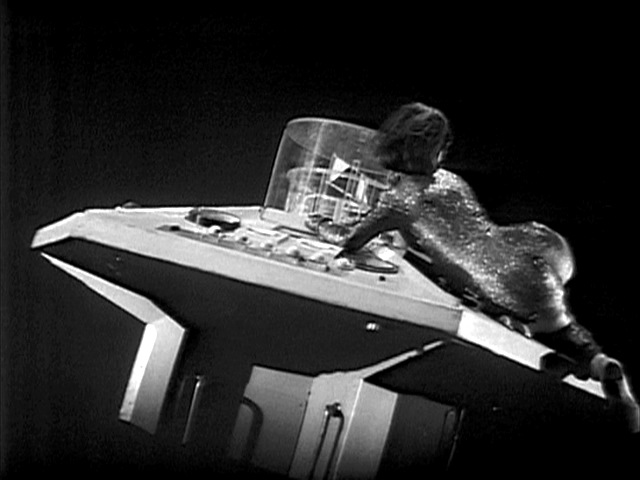 7. Mind Robbed! - The Mind Robber
In the climax to the opening episode of The Mind Robber, the Second Doctor, Jamie and Zoe are stuck in the TARDIS as it falls out of time and space and into nothingness. The Doctor's machine breaks apart and sends its insides - including the console and its adventurers - out floating into a black void until they are engulfed into a thick smoke. Expertly directed and scored with some throbbing, eerie music, sixties Doctor Who was never more psychedelic than in this moment which shows just how the series stretched and explored itself back in its first few years.
 6. 'Nobody in the universe can do what we're doing...' - Tomb of the Cybermen
In the middle of this magnificent serial (Matt Smith's favourite classic Who story, don't you know) involving adventuring archaeologists and legendary Cybermen rising from their tombs comes a tiny moment between the Second Doctor and his new companion, Victoria, who is reflecting on the loss of her father (killed by Daleks in the previous story). Comforting her the Doctor tells her of the memory of his own family and how the life the TARDIS offers will help ease her grief, as there will be 'so much to see.' It's a terribly sweet scene that has nothing to do with the overall story but proves that the classic series can do moments of heart every bit as well as the modern series can.
 5. 'No regrets, no tears, no anxieties.' - The Dalek Invasion of Earth
 And, just because I'm trying to get you crying, here's another tear-jerker. The Doctor's granddaughter, Susan, is torn between going with her grandfather or to help rebuild a Dalek-ravaged future Earth alongside David Campbell, a man she has fallen in love with. Making the decision for her, a hurt Doctor closes the TARDIS doors then gives her a farewell speech from inside. First Doctor William Hartnell usually hated giving long speeches but here he delivers every line with aplomb, putting a stiff-upper lip on as the Doctor tells Susan that she is a girl no longer and cannot travel with him anymore. It's the first exit of a companion and it is still one of the best.
 4. Dalek! - The Daleks
In just the second story of Doctor Who ever, the Daleks make their first appearance. However, our first glimpse of the Dalek is not so much a great reveal but more of a tantalising tease. At the end of the opening episode of the story, Barbara is wandering through the corridors of the Dalek's metallic city on Skaro when she encounters one of the creatures for herself. All we see, though, is her pinned to the wall by a sink plunger-like arm. There's not even a cry of 'exterminate.' A simple, suggestive and rather brilliant entrance for the Doctor's eternal worst enemies.
 3. Trial of a Time Lord - The War Games
Nowadays, even casual viewers of the series know a few basic things about the Doctor; and one of those is that he is a Time Lord. However, it wasn't until the Second Doctor's final episode, six years into the show, that the name of his race was revealed. Kidnapped by his people, the Doctor is accused for leaving his home planet and meddling in time - his punishment: he will be exiled to 20th century Earth and forced to change his face. It's a real turning point for Doctor Who; finally, we know something about the Doctor and it neatly sets up the premise of the Third Doctor's tenure. The show wouldn't be the same again.

The jaws of many viewers at home must have hit the floor when they saw this for the first time. After his first meeting with the Cybermen, the Doctor, old and tired, falls to the ground. Surrounded by his friends, Ben and Polly, the Doctor seems to be dead - but, wait - in a flash of light, the old Doctor is gone and the Second Doctor is born. Watching this scene back now just reminds you what a fantastic idea that of regeneration is. Not only because it keeps the show going but also for its dramatic potential; Can Ben and Polly trust this new man? Can he really be the Doctor? Fab stuff.
 1. The First Journey - An Unearthly Child
Twenty minutes after Number Ten on this list, we follow Ian and Barbara as they follow their oddball student Susan home - to an out-of-place Police Box in a junkyard. Inside, they discover a gleaming console room of a spaceship and that Susan and her crotchety grandfather are actually time-travelling aliens. Believing that Ian and Barbara would tell his secret, the Doctor takes off from Earth, bringing the school teachers with him. As we hear the familiar wheezing noise for the first time, the TARDIS materialises in a prehistoric landscape. Just as a shadow passes over it. It's a simply sublime moment, taking us from an ordinary junkyard to millions of years into the past in an instant. It's bread and butter Doctor Who but here it really does feel brand-new; no other scene of the TARDIS disappearing one place only to reappear somewhere else is as enthralling as this one. No wonder Messrs Moffat and Davies were inspired.
Return next month for more of Doctor Who's Greatest Moments!
Subscribe to:
Posts (Atom)
