Tuesday, 8 October 2013

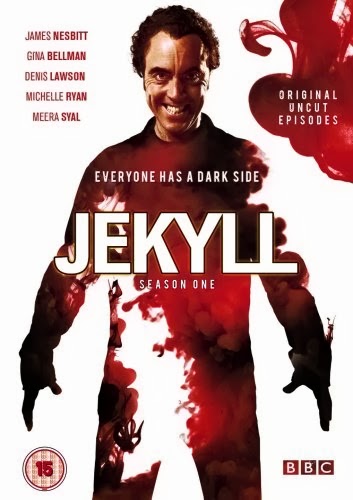
Review: Jekyll (Series One)

Everyone has a dark side. This is the theme of today's post. We may appear trustworthy members of society but underneath may lurk a secondary savage nature. The side you try to hide. the side you try to bury deep and the side that may come to the fore and close this tab if I keep up this melodramatic introduction. So, as Gothic Creatures month continues, we turn our two-faced heads to inspect a new take on a classic tale...


Three years before he reinvented Sherlock Holmes as a modern-day sleuth, Steven Moffat brought another icon of late-Victorian literature into the 21st century - the tragic Dr Jekyll and his twisted other half, Mr Hyde.
Jekyll, a sequel to the Robert Louis Stevenson original, sees James Nesbitt (ubiquitous on British television back in 2007, he can now be seen as Bofur in The Hobbit films) as Dr Tom Jackman, a man who is suffering from serious split personality. Cutting himself off from his job, friends and family, he is determined to defeat his inner demons before they - or should that be 'he' - can bring harm to his loved ones. Jackman, a descendant of Dr Jekyll, can trust no one - not even himself. 

As one can expect from Steven Moffat, the king of complex plots, this short six-part series (no more were produced) hurtles at a strong pace and is unpredictable to the extreme. While this is far from being the only reimagining of Jekyll and Hyde, to take the Victorian gothic novel and turn it into a contemporary conspiracy thriller show as this does is really quite inspired. Thankfully, however, Jekyll manages to never take itself too seriously and supplies another thing one will always find in Moffat's work; more than a handful of humour. Mr Hyde - oh, yes, he still calls himself that - is portrayed as a camp, so-mad-he-loves-being-evil villain in the vein of John Simm's The Master and, later, Andrew Scott's Moriarty and so regularly gets you laughing with him, despite his nasty nature. 
Across the episodes, there are some stonking great classics of Moffat dialogue. My favourite has to go to the following exchange that's played to deadpan perfection by Nesbitt:


Jackman finds a CD titled 'Disney Favourites' on his desk
Tom: What's this?
Katherine: It's his.
Tom: He has Disney favourites?
Katherine: He likes the songs.
Tom: My dark side likes Mary Poppins. No wonder I was bullied at school.


The cast is filled out ably by familiar actors to any British TV viewer, including Meera Syal, Denis Lawson and Michelle Ryan. Ryan plays Katherine, Jackman's capable assistant who helps keep Hyde at bay (by giving him Disney CDs, apparently) while Syal and Fenella Woolgar (Who's Agatha Christie) play a pair of lesbian private detectives - clear forebears of Moffat's much-loved crinolined crime-fighting duo Madame Vastra and Jenny. They are all entertaining additions to the cast but sadly fall a bit by the wayside in the series' latter half as the plot spirals all over the place (in a good way). On the plus side, though, Gina Bellman who is underused in the first episodes gets a chance to shine as Jackman's suffering wife.
As the issues with character above suggests, the show does have its problems. The biggest being that there's something about it that means the series as a whole just doesn't click. It's certainly great fun to watch but it is the show's inability to ever quite come together that keeps the production from reaching the heights of Sherlock and Moffat's Doctor Who. While the writing runs the show and the actors carry it well, it seems like one-part generic TV drama and one-part bonkers, innovative stuff. The series was clearly designed as a vehicle for Nesbitt, who plays both roles with either suitable restraint or bouncing energy, and also allows Moffat to go solo on a big-game drama project for the first time. Perhaps it is these manufactured beginnings that stop Jekyll being a truly great piece of television.

On the whole, Jekyll is a hugely enjoyable series with sharp writing and solid performances but one that never quite fires on all cylinders. With elements of both pure genius and mediocrity, Jekyll really is a show split down the middle, meaning that the series may leave the viewers themselves in two minds.  

Wednesday, 2 October 2013

Favourite Fictional Characters: Ellen Ripley by Mr Rumsey

To kick off the special gothic-themed run of posts that are going up this October, here's the second in an ongoing series by guest bloggers on their favourite fictional characters. This month, James Walpole, of Mr Rumsey's Film Related Musings, is discussing his favourite character, the lead from the classic Sci-fi/Horror film series Alien. Before we start, let's give a big hand to Mr Rumsey for putting together an out-of-this-world article! Done that? Good. The one of you who is now missing an arm, I'll give it back to you another time...


Ellen Ripley has come to symbolise the ultimate female character for me, the one by which I measure all others across film, literature, and video games. She undertakes a transition across four films that promotes the maternal instinct, intelligence, bravery and an ability to adapt and survive in ways which are almost exclusively reserved for male characters, whilst the films also confront issues of rape, sexual threat, and the loss of a child, and Ripley is developed enough to make mistakes, miscalculate a situation, and react impulsively.  This incredibly strong character is important to me not only as a landmark in film and gender history, but also because I've grown to really like her. She is endlessly entertaining; whether she is being funny and ballsy, or is terrified and fighting for her and others’ lives. What’s more I can really relate to her struggles, and that’s something that’s very important considering I'm a young male viewer in his early twenties.

Although Ripley has a handful of romantic connections to other characters, even if some of these are barely hinted at or are left on the cutting room floor, she does not suffer as a character from these relationships. She is never constructed through these male figures, and miraculously she passes through the hands of multiple screenwriters and directors, without ever once becoming the besotted and helpless female archetype. Yes, she is portrayed as an object of sexual desire, and by that I mean both for humans and aliens, but she isn't defined by that attribute unlike many female characters. Her sexual appeal is considerably more relevant to the series’ concerns with sexual fear, rape, abortion, childbirth and the male psychological fear of impregnation, than it is relevant to her character traits.

When I watched Alien, Ripley was one of the first empowered female roles that I had experienced. I use the term empowered carefully as I think it is quite troublesome, and I certainly do not believe that a well written female character needs to take on ‘male attributes’, i.e. picking up a gun and being able to kill, this technique often backfires anyway. Ripley is empowered because she is fully fleshed out as a character; she’s alternatively weak and strong in different situations, she is conflicted, she makes mistakes, but she also learns from them - look to the supporting character Lambert to see the female role that Ripley has evolved from. I knew that I had found something here that strongly affected me. Ever since I re-watched this film I have had a very strong interest in female roles, they now are normally the characters which interest me most when I read/watch/write something, and this part of my personality, I've come to realise through writing this post, is largely tied into the character of Ripley.

Ellen Ripley has few real rivals in terms of female film characters; Sarah Connor is perhaps her only true challenger, but you could also consider Louise (Thelma and Louise), Beatrix Kiddo (Kill Bill), Raimunda (Volver), or say Marge Gunderson (Fargo). The reason for me that she rises above these other great characters is simply that none of those have such a rich and developed character, one that has been built-up over time and multiple films into being a strong female role model – a woman that doesn't rely on her sexuality, but is both believable and relatable.


If you are interested in contributing a future guest post, please send me an email at chalbo@outlook.com, tweet me at @ChristianABone or leave a comment below!

Tuesday, 1 October 2013

Welcome to Gothic Creatures


A monochrome man, dressed in a smart suit, appears through the stage curtains and speaks to an unseen audience.

Ladies and gentlemen, boys and ghouls, the writer of this blog thought it best to warn you of what is to come on his site over this October, in the run-up to that fabled night, All Hallow's Eve.

For one month only, Scribble Creatures will be devoted to all things Gothic. Things to curdle the blood and quicken the beatings of the heart, as mistress of the macabre Mary Shelley once said. If you can stand it, you will be treated to reviews, list articles, guest posts all to do with some of the most nightmarish books, films and television around - and perhaps even a short story to read on Halloween night. If you dare.
I urge you to visit this blog over the next month with the utmost caution. The posts that follow this are not for the faint of heart and the blog's proprietor will not be held responsible for any -
Well, don't say we didn't warn you...

The monochrome man  grins and exits the stage.


Tuesday, 24 September 2013

Doctor Who's Greatest Moments: Part Two - The 70s

Following on from last month's walk through memory lane at the best moments in Sixties Doctor Who, now we turn to, you've got it, the seventies, which saw two very distinct eras go by (or almost, in Tom Baker's case). While the sixties are usually seen as the show's experimental decade, playing with what the series could do, the early seventies were really far more so. With a whole new look for the show - the Doctor now finally travelled in colour, as well as through time and space - Doctor Who was also made into a contemporary thriller series; marooned on present-day Earth, the Third Doctor is attached to a division of the army dedicated to thwarting alien threat. By the later seventies, however, the show went back to its roots - with the Doctor once again a hobo in space - but retained the Third Doctor's era's rousing sense of adventure, arguably becoming the most assured era of the series' original run. Whatever your viewpoint, the seventies certainly contains some of Doctor Who's greatest stories - and, by extension, some of its greatest moments.

10. In Paris, City of Death

Near the beginning of Douglas Adams' City of Death, one of the show's greats, comes a low-key but special moment. Making the most of the episode's overseas filming, we are shown a medley of the Doctor and Time Lady Romana, enjoying themselves around the city, accompanied by Dudley Simpson's memorable score (recently heard at this year's Doctor Who at the Proms). In a story full of great comedy moments and a rather fabulous monster reveal, this beats the lot by giving us something a little rarer in Who; the chance to see the Doctor and his companion having a good ol' time away from extraterrestrial shenanigans. And, you know what, they look like they're having fun.

9. The Doctor in the shower, Spearhead from Space

In the previous regeneration up to this point, the Doctor had changed from Hartnell to Troughton with virtually no problem whatsoever, going off to defeat the Daleks and be back inside the TARDIS in time for tea. However, for a long while after the Third Doctor's 'birth' he remains unconscious in a hospital bed before crying out for his shoes and, later, indulging in a spot of singing in the shower. Apart from the fun seeing comic actor Pertwee larking about in a role that he usually played straight, this moment's also significant for being the first of the post-regeneration 'silliness' scenes, in which the still-cooking Doctor will be rather hyperactive. Nowadays, every regeneration is accompanied by something reminiscent of this scene but it remains the original and one of the best.

8. Alternate 1980, Pyramids of Mars

From the moment the Fourth Doctor discovers that Sutekh the Destroyer is trying to break his bonds, his signature toothy grin is nowhere in sight; it is clear this is a fierce opponent. Knowing how much trouble they could be in, Sarah Jane suggests they get in the TARDIS and leave. In answer, the Doctor does just that and returns to Sarah's hometime of 1980 - and it is a barren wasteland. This is the future of the Earth, the Doctor tells her, unless they stop Sutekh. It's a brilliantly effective scene and one that perfectly captures who the Doctor is. Despite the danger posed to himself, he will do anything to ensure that human - or any - lives will be saved. In short, he's a hero. And gawd bless him.

7. The Many Faces of Doctor Who, The Brain of Morbius

We may know that the Doctor's a hero but, as a fantastic moment in Fourth Doctor story Brain of Morbius shows us, we don't really know much about him at all. The Time Lord criminal Morbius, his brain inhabiting a mish-mash alien creature, has engaged the Doctor in a battle of the minds and is pouring through his thoughts. We see all four of his faces appear on screen and then - what?! - several more. 'How long?' the creature cries. 'How long have you lived?' The idea of the Doctor living more lives than those we have seen is a tantalising one - and something I'm glad to see is being explored in the coming The Day of the Doctor. This is such an important scene as it reminds us of that eternal question; Doctor Who?


6. A dandy and a clown, The Three Doctors

Multi-Doctor stories are always great fan-pleasers - what could be better than several incarnations of your favourite hero coming together in a big nonsensical celebratory bash? And for seventies viewers who watched the first occasion this happens on screen, in The Three Doctors which marked the show's tenth - aw, bless - anniversary, it must have been simply the best. Brought together by the Time Lords, the Second and Third Doctors argument is cut short by the appearance of the First Doctor on the TARDIS scanner. However, he doesn't treat his other selves with much more respect. 'So you're my replacements,' he says. 'A dandy and a clown', thereby creating one of the most famous of Doctor Who quotes. This November's 50th anniversary shindig will hopefully provide some fun multi-Doctor moments but it will be hard pressed to beat the first. The original, you might say.


5. 'Where there's life, there's a...', Planet of the Spiders

Realising he is to blame for the attack of the Eight Legs, a race of giant spiders (see number 3), the Third Doctor returns to Metebelis III to stop the Great One and her plans to rule the universe (don't alien monsters ever want a quiet life?). With the spider destroyed, the Doctor returns to his TARDIS having saved  the world - but at a cost. He has been hit with a deadly dose of radiation. Arriving at UNIT HQ, watched by Sarah Jane and the Brigadier, the Third Doctor dies and a new man rises from the ashes. With its Buddhist undertones and many facets that would be used in later deaths of Doctors - accepting their own passing for the greater good, for instance - this is a superior regeneration scene.

4. 'Do I have the right?', Genesis of the Daleks

At the climax of this Dalek-origins story, the Doctor has a tough decision to make. At Davros' incubation room - the birthplace of all Daleks - the Doctor has only to connect two wires to destroy the room, and the Daleks will be wiped from history. But the Doctor's moral conscience is too great. He would be committing genocide - surely making him as bad as the Daleks themselves. Thankfully, though, the decision is taken out of his hands as the Doctor and his friends are found. Not only a brilliant character moment for the Doctor - Russell T Davies has said that the Doctor's meddling in the Daleks' creation sparked the Time War - it also embodies a thought-provoking philosophical and moral question. What would you do in that situation?

3. A Parting Gift, The Green Death

Companion exits are always among the most memorable and, let's admit it, emotional of Doctor Who moments and the time the clumsy but lovely Jo Grant decided to leave the Doctor's side is sure to tug at any Who fan's heart. At a UNIT celebration, Jo announces she is getting married to another adventuring scientist, Professor Cliff Jones. Cut up, the Doctor gives Jo her wedding present, a crystal from Metebelis III (a crystal the spiders of the planet will later want back...) and, as the rest of the party congratulates the couple, the Doctor slips quietly away. The scene is played to perfection, with so much left unsaid by the pair. Sadly, the Doctor is used to goodbyes...

2. 'Don't Forget Me', The Hand of Fear

After a trying adventure, Sarah Jane is feeling tired of travelling the universe.And, at the same time, the Doctor receives a call from Gallifrey, where he must go alone. Departing on good terms, the Doctor and Sarah Jane say farewell. 'Don't forget me,' she tells him. 'Oh, Sarah Jane,' he replies, 'don't you forget me.' A masterclass of underacting, Tom Baker and Elisabeth Sladen are both excellent here. As with Jo's leaving scene, both the Doctor and his companion know their time together is up. They have grown-up. And the Doctor can't stand to see that happen; the one thing he can never do. Overall, this is a bittersweet ending to perhaps Doctor Who's best TARDIS team.

1. Indomitable! The Ark of Space

The moment from seventies Doctor Who I'm naming as the best is not a fond farewell to a much-loved companion or a heartbreaking death of a Doctor, but is in fact a moment of reflection by the Time Lord on his favourite species. Finding themselves on Nerva Beacon, the last refuge of humanity in the far future, the Doctor and Harry discover countless humans cryogenically frozen, sleeping until they find a new world. 'Homo Sapiens,' booms the Doctor, beginning a speech that waxes lyrical about the invincibility of the people of the Earth. We know that the Doctor loves Earth but in this scene we get to see the full extent of his admiration for us. He's almost proud, like a father pleased with how his children have turned out. 'They're indomitable,' the Doctor wraps up. 'Indomitable.' Much like Doctor Who itself, really. No matter how much it changes, it just keeps going. Ready to outsit eternity...? Who knows.

Friday, 13 September 2013

Review: The Ocean at the End of the Lane

After the rest of the world has long since devoured Neil Gaiman's latest offering, and a few weeks since I received a signed copy from the man himself, here, a little late to the party, is my review of the superb The Ocean at the End of the Lane. Don't be shy, dive in.


We all remember being scared as children. Of a curtain blowing in the wind from the window, of a misshapen shadow falling on the wall or, for this reviewer at a certain age, of a velociraptor in a chequered shirt coming up the stairs to eat you (don’t ask. No really, don’t). These sorts of memories can be some of the strongest that we retain from childhood. But, usually, there’s a relief at the end; a closing of the window, a switching on of the light, an …even bigger dinosaur protecting you. However, sometimes children have real reason to be scared. And the narrator of The Ocean at the End of the Lane certainly does.

After his family’s lodger, the opal miner, is found dead, our narrator is caught in a helpless situation as his cosy seven-year-old world is torn apart when an ancient entity with the power of a god is released. With designs for the flint lane on which he lives and the people in it.

A lot has been said about the novel's themes of memory and reflection yet, although these are integral to the atmosphere of the piece, what must not be forgotten is that Gaiman weaves together a gripping story which at its core is about the terror and triumph of childhood. What separates this from Gaiman’s other works that feature children against otherworldly forces – for instance, The Graveyard Book and Coraline – is that the novel is a recollection of an adult narrator back to his childhood and the horrors that he faced. Because of this, probably why it was a book aimed at adults rather than children, there is a stronger air of hopelessness to proceedings; a feeling of being totally lost in a grown-up world. Thankfully, though, there is some light at the end of the lane…

For this reader, the Hempstocks are the stars of the piece. The three women of varying ages, who live on the old farm at the street’s end, are ancient, wise beings themselves. ‘The ocean’ of the title sits in their land – it’s actually a duckpond, but one with a few secrets. As a child, I think we all dreamt that something or someone where we lived was different and out-of-the-ordinary and Gaiman personifies this perfectly in the heroic Hempstock women.

However, heroes and monsters are all well and good but perhaps when the novel is at its most involving is in its mixing of this other world the boy encounters and his own family. As a child, our family is our bedrock and when it is at risk there’s nothing more terrifying. We can all find something we recognise in our own family in the one the author creates and so, when the cracks appear in it and his parents fail to help their son in his predicament, Gaiman's exquisite prose takes us all back to being a scared, defenceless child.

Overall, the book is an excellent composite between the author’s adult fiction and his output for younger audiences, and is really suitable for the young and old, who will read it from different perspectives. Give it a go and you’ll find it’s easy to get lost in the ocean of fear and magic and fairy tale that runs through the heart of Gaiman's novel. The Ocean at the End of the Lane may make you revisit a time of moving curtains, lingering shadows and shirted dinosaurs but you might just feel richer for it.

Sunday, 1 September 2013

Favourite Fictional Characters: Samantha Carter by @missvariety

Earlier this year, I announced that I was planning to do a blogathon on the subject of favourite fictional characters. However, recently I had a change of heart (to quote a certain criminal mastermind: 'I'm so changeable!') and decided it will now be a monthly feature. Hopefully, readers of this blog will enjoy other wonderful, talented fiction-fans talk about their favourite characters - to make a change from me blabbing on about mine (go on, have a guess who they are). First up, a huge thanks to @missvariety for writing this great, personal piece  - worthy of opening this new series of guest posts for your enjoyment. 


There are many TV shows, books, games and films that I love and within their stories contain some of my favourite characters. Many of these are recent adventures, either still being produced in the pages of novels or broadcast on our televisions. However, my choice takes me back to when I was a teenager, a TV series I was introduced to by my Dad and has often shaped my own interests and personality.  

Stargate SG-1 had already been running for seven seasons until I discovered season eight as it aired. Immediately captivated I spent the following summer earning enough money each week to buy a season. The story itself deeply interested me due to its basis in our own history; one of the characters was an archaeologist, a profession I'd wanted to follow for years. The discovery of a Stargate, a ring that produced wormholes which could transport you across space, opened a whole new realm of possibilities. The characters themselves were relatable and fascinating. The world created felt real. It was my first real fandom, and I was hooked. 

Of course, it was also my first introduction to a very real, and a very impressive female character. Samantha Carter walked into the first season as Captain, and left as a Colonel, with a brief stint in command of the off-world base at Atlantis. Sam was my first experience of a strong, independent and intelligent fictional female role model. What makes Sam stand out from the others is her attitude; she’s in the militaryshe’s a woman in a man’s worldShe enters the first episode defending her own gender, she’s not to be argued with nor put down. As each episode is concerned with travelling through the Stargate a new culture is visited each time which often challenge our own perception of the world, as we do theirs. A first season episode entitled 'Emancipation' contained a community where it was believed that women were ''property''. Through this episode Sam challenges this view, ultimately winning a battle of hand to hand combat with the chieftain in a display of strength and agility. 

However, Sam is most well-known because of her intelligence. Sam is a scientist, and a bloody good one at that. She engineered a lot of the technology around making the Stargate work, and is quite expert in her field. If something needs a scientific fix, Sam’s the one that makes it happen, and this often happens. Yet she’s not just an action hero. She’s also very compassionate, loving, but foremost, very loyal. For me, personally, Sam Carter was a realisation that women didn't have to be quiet, we could be badass and awesome. Sam was everything I ever wanted to be. Sam was my first, and my best, role model. 


If you are interested in contributing a future guest post, please send me an email at chalbo@outlook.com, tweet me @Chalbo100 or leave a comment below!

Wednesday, 28 August 2013

Doctor Who's Greatest Moments: Part One - The 60s


Doctor Who has had many a memorable moment over the years and, this month, in a new series of posts dedicated to the series' best bits, we're looking at the show in its first decade of life; the swinging sixties! Moments like the ten below lodged themselves in viewers' heads, turning a generation of children into fans of this peculiar, sometimes silly, always wonderful programme. Some of those watching at this time, kids such as little Russel T Davies and miniature Steven Moffat loved the show enough to grow up and make it! So there we are, these moments that you are about to read about helped ensure Who is still with us today. Not bad for a show originally conceived as a children's educational series. Although it quickly grew into something much bigger. Bigger on the inside, you might say...                                                  

10. The First Moment - An Unearthly Child

The very first shot ever in Doctor Who is so indicative of the programme. As the chilling theme music fades out for the first time we are shown a out-of-place Police Box (still a familiar item to viewers at the time) standing in a junkyard, with a strange hum coming from inside...
Such an iconic image, the TARDIS returned to the same junkyard under the control of the Sixth (in Attack of the Cybermen) and Seventh Doctors (Remembrance of the Daleks) and it landed in a junkyard planet in the more recent The Doctor's Wife but this original moment is by far the most spine-tingling. Only a few seconds into the first episode and already we have the alien mixed with the everyday - the stuff Doctor Who is made of!


9. Cybermen from the Sewers! - The Invasion

In this Second Doctor adventure, present-day Earth is being invaded once again by the deadly Cybermen. The Cybermen had faced the Doctor already several times before (see Number 2) but this story features perhaps their most famous moment. Rising from the sewers of London, the metal men stride down the steps by St Paul's, ready to take the planet. Of course, they don't and, in a few episodes time, they're sent packing but in this moment the Cybermen seem a terrible threat. One of the original and best Behind-the-Sofa moments for which the show is so famed.


8. Time Can't be Rewritten - The Aztecs

In the early years of the show, the Doctor vehemently enforced the rule that you could not interfere with history. Many episodes saw the TARDIS crew witness history happening rather than getting stuck into it themselves. However, in The Aztecs, the Doctor's companion and history teacher Barbara tries to change history for the better by posing as an Aztec Goddess to stop them sacrificing people. Unfortunately, her efforts only cause more trouble and the Doctor gives her a stern talking to. Long before Moffat's timey-wimey plotting and Davies' character-driven stories, this is one of the show's first forays into the opportunities of time travel and also the effect it has on the Doctor's friends.

7. Mind Robbed! - The Mind Robber

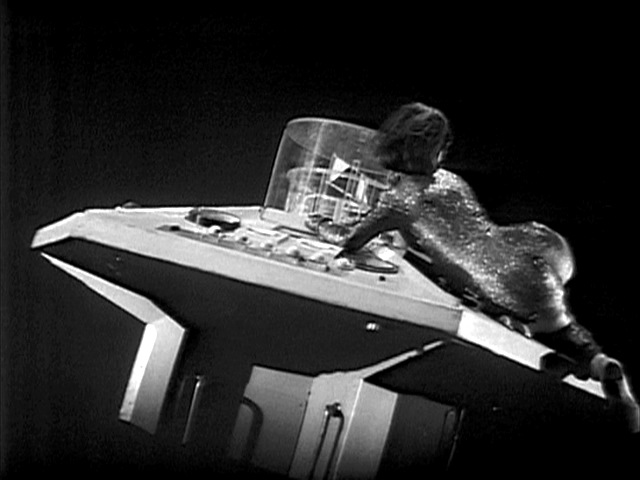
In the climax to the opening episode of The Mind Robber, the Second Doctor, Jamie and Zoe are stuck in the TARDIS as it falls out of time and space and into nothingness. The Doctor's machine breaks apart and sends its insides - including the console and its adventurers - out floating into a black void until they are engulfed into a thick smoke. Expertly directed and scored with some throbbing, eerie music, sixties Doctor Who was never more psychedelic than in this moment which shows just how the series stretched and explored itself back in its first few years.

6. 'Nobody in the universe can do what we're doing...' - Tomb of the Cybermen

In the middle of this magnificent serial (Matt Smith's favourite classic Who story, don't you know) involving adventuring archaeologists and legendary Cybermen rising from their tombs comes a tiny moment between the Second Doctor and his new companion, Victoria, who is reflecting on the loss of her father (killed by Daleks in the previous story). Comforting her the Doctor tells her of the memory of his own family and how the life the TARDIS offers will help ease her grief, as there will be 'so much to see.' It's a terribly sweet scene that has nothing to do with the overall story but proves that the classic series can do moments of heart every bit as well as the modern series can.

5. 'No regrets, no tears, no anxieties.' - The Dalek Invasion of Earth 

And, just because I'm trying to get you crying, here's another tear-jerker. The Doctor's granddaughter, Susan, is torn between going with her grandfather or to help rebuild a Dalek-ravaged future Earth alongside David Campbell, a man she has fallen in love with. Making the decision for her, a hurt Doctor closes the TARDIS doors then gives her a farewell speech from inside. First Doctor William Hartnell usually hated giving long speeches but here he delivers every line with aplomb, putting a stiff-upper lip on as the Doctor tells Susan that she is a girl no longer and cannot travel with him anymore. It's the first exit of a companion and it is still one of the best.

4. Dalek! - The Daleks

In just the second story of Doctor Who ever, the Daleks make their first appearance. However, our first glimpse of the Dalek is not so much a great  reveal but more of a tantalising tease. At the end of the opening episode of the story, Barbara is wandering through the corridors of the Dalek's metallic city on Skaro when she encounters one of the creatures for herself. All we see, though, is her pinned to the wall by a sink plunger-like arm. There's not even a cry of 'exterminate.' A simple, suggestive and rather brilliant entrance for the Doctor's eternal worst enemies.

3. Trial of a Time Lord - The War Games

Nowadays, even casual viewers of  the series know a few basic things about the Doctor; and one of those is that he is a Time Lord. However, it wasn't until the Second Doctor's final episode, six years into the show, that the name of his race was revealed. Kidnapped by his people, the Doctor is accused for leaving his home planet and meddling in time - his punishment: he will be exiled to 20th century Earth and forced to change his face. It's a real turning point for Doctor Who; finally, we know something about the Doctor and it neatly sets up the premise of the Third Doctor's tenure. The show wouldn't be the same again.

2. 'It's far from all over...' - The Tenth Planet

The jaws of many viewers at home must have hit the floor when they saw this for the first time. After his first meeting with the Cybermen, the Doctor, old and tired, falls to the ground. Surrounded by his friends, Ben and Polly, the Doctor seems to be dead - but, wait -  in a flash of light, the old Doctor is gone and the Second Doctor is born. Watching this scene back now just reminds you what a fantastic idea that of regeneration is. Not only because it keeps the show going but also for its dramatic potential; Can Ben and Polly trust this new man? Can he really be the Doctor? Fab stuff.


 1. The First Journey - An Unearthly Child

Twenty minutes after Number Ten on this list, we follow Ian and Barbara as they follow their oddball student Susan home - to an out-of-place Police Box in a junkyard. Inside, they discover a gleaming console room of a spaceship and that Susan and her crotchety grandfather are actually time-travelling aliens. Believing that Ian and Barbara would tell his secret, the Doctor takes off from Earth, bringing the school teachers with him. As we hear the familiar wheezing noise for the first time, the TARDIS materialises in a prehistoric landscape. Just as a shadow passes over it. It's a simply sublime moment, taking us from an ordinary junkyard to millions of years into the past in an instant. It's bread and butter Doctor Who but here it really does feel brand-new; no other scene of the TARDIS disappearing one place only to reappear somewhere else is as enthralling as this one. No wonder Messrs Moffat and Davies were inspired.


Return next month for more of Doctor Who's Greatest Moments!
Related Posts Plugin for WordPress, Blogger...